
Object Record
Images
Metadata
Catalog Number |
1863.1.1 |
Collection |
U.S. Presidents |
Object Name |
Painting |
Title |
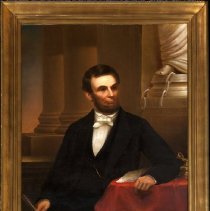
Abraham Lincoln |
Artist |
Edward Dalton Marchant |
Date |
1863 |
Year Range from |
1863 |
Signed Name |
"E.D. Marchant/From Life 1863" |
Signature Location |
middle left |
Description |
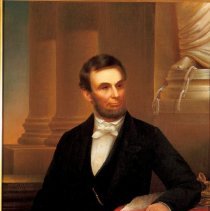
The artist has represented Lincoln with his arm resting on a table, the Emancipation Proclamation before him, representing the League's acceptance of Lincoln's signing of the Emancipation Proclamation, a policy that divided the Republican party. In the background, the lower part of a statue of Liberty can be seen; the chains of slavery are shown broken around her feet, foreshadowing the North's victory and the end of slavery. |
Medium |
Oil on canvas |
Dimensions |
H-55 W-45 inches |
Notes |
A letter that League member and newspaper publisher John W. Forney wrote to Lincoln on December 30, 1862, demonstrates that the commission was originally destined for Independence Hall: "My Dear Mr. President - The bearer, Mr. E.D. Marchant, the eminent Artist; has been empowered by a large body of your personal and political friends to paint your picture for the Hall of American Independence. A generous subscription is made-- and he visits you to ask your acquiescence, and to exhibit his testimonials. He will need little of your time. There is no likeness of you at Independence Hall. It should be there; and as Mr. Marchant is a most distinguished Artist, and is commended by the most powerful influences, I trust you will give him a favorable reception--" Lincoln agreed to the request, and Marchant went to Washington, D.C., to paint the portrait. Marchant was permitted to live and work in the White House for four months in 1863. Marchant described the portrait and its symbolism in a letter dated May 24, 1863: "It represents President Lincoln of the half-size, and at half-length. As sitting by a table covered with a crimson cloth, on which lies his Emancipation Proclamation, just signed, the pen being still held in his hand. The general attitude, and the expression of the countenance, indicate earnestness and decision, and his head turns to welcome some friend, who is supposed to be just entering the apartment. A screen of columns in the distant background is seen through an opening in the architecture behind him; while nearer and over his left shoulder, I have placed, in a nice, a statue of the Goddess of Liberty, whose right heel tramples a riven chain. In this I have sought, and I am told with success, to symbolize, on campus, the great, crowning, act of our distinguished President. The act, which more than all other, must signalize the grand epoch in which we are priviledged [sic] to live." In another letter to the portraitist Daniel Huntington, Marchant explained the presence of Lincoln's unusual white cravat: "He rarely wore it, but in some instances had done so, among others at some weddings. This decided me to adopt it for its better pictorial effect. The scant neck-tie he usually wore seemed in this case, utterly unsuited to a portrait; its sharp black line, like a gash seemed to sever the head from the body, it appalled me." After Marchant had completed the portrait in August, it was placed in Independence Hall. It did not remain there, however, as the caption on a mezzotint engraving of the portrait by John Sartain in 1864 states that it was "in the possession of the Union League of Philadelphia." Lincoln commissioned Marchant to paint a copy of this portrait for his friend, the solicitor of the War Department William Whiting that is now in the collection of the Concord Free Public Library in Concord, Massachusetts. References: Whiteman 1978, pp. 49-50. Harold Holzer, Gabor S. Boritt, and Mark E. Neely, Jr., The Lincoln Image: Abraham Lincoln and the Popular Print (New York: Charles Scribner's Sons, 1984), pp. 101-110. Barry Schwartz, "Picturing Lincoln," in Picturing History: American Painting 1770-1930, ed. William Ayres [exh. cat., Fraunces Tavern Museum] (New York, 1993), pp. 137-139, color illus. Torchia 2005, pp. 28-29, color illus. |
Provenance |
This portrait was painted from life between February and August of 1863, while the artist lived in a small apartment in the White House. The portrait was intended to hang in the State House (Independence Hall) to remind Philadelphians to support their President during the Civil War; it did hang there briefly. Once the War ended and Lincoln was dead, however, it was no longer needed to encourage support for the President, so it was returned to the League. |
Legal Status |
Owned by the Union League of Philadelphia |
People |
Lincoln, Abraham |